
Before beginning a project, there are some things to consider. If your doll is rare or popular with collectors, even in poor condition it could be quite valuable. In this case, repair to the doll could actually lower its value. Personally, I don't like my dolls to look like mugging victims, even if they are valuable in that state. Still, even the greatest dolls can be in such poor shape that they can be nearly worthless. Then there's little to lose. I suggest you find an unmarked doll of medium size that is really in sad shape to try the techniques I'm going to show here. If your first doll is a disaster, you haven't lost much. On the other hand, compo is forgiving and just about everything I show you can be repeated until you get it right. Just take your time and have fun with this!
REPLACING MISSING LASHES
Often on eBay I see a listing with the text something like "a few missing lashes but these can be easily replaced.." I hope this will show you that it's not that easy, but can be done. It just takes patience and practice. This is a great example of a project that should be tried out on a doll that isn't too valuable. You may not get it right the first time and there are a few pitfalls.
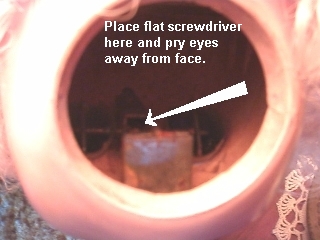 |
The first thing you need to do is remove the head and then remove the eye assembly. On most of the compo and hard plastic dolls the eyes are on clinchers. This is a bar clamped to the inside of the bridge of the nose on which the eyes rotate to open and close. To remove the eye assembly, I put a flat headed screwdriver into the clamp and twist and pry until the clamp opens and the eyes come away from the inside of the face. |
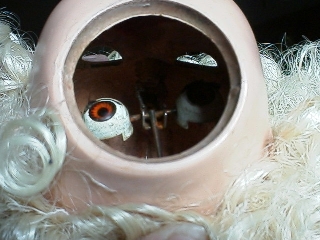 |
Here you can see the assembly is almost free. Once it is loose, you can grasp it by the counterweight and turn it so that the eyes can come out of the head at an angle. Remember this procedure because when the lashes are done, you can put the assembly back into the head at the same angle. |
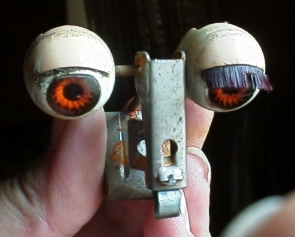 |
So the clinchers are out and now we can see what needs done. On these, the right eye has only a few lashes missing and the left has all the lashes broken off. The lashes are in a slit in the metal ball and held by glue or sometimes a strip of paper inside the eye. Generally, if more than half of the lashes are missing, I pull out the rest and start from scratch. |
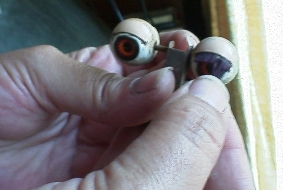 |
Use tweezers to pull out any broken lashes that you're going to replace. Poke a fine needle into the slit that held the missing lashes to make sure it's free of any lash remnants or glue. When you can hold the eye up to the light and see the hole is unobstructed, you're ready to replace lashes. Cut lashes from a brush and poke them into the hole a few at a time. Don't worry about length yet. |
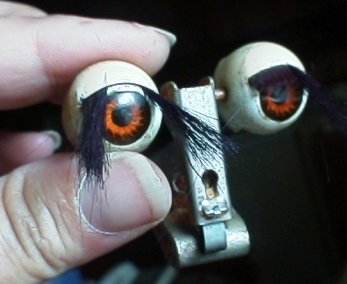 |
On the eye with no remaining lashes, push them into the center of the curve and then work them over to the edges. |
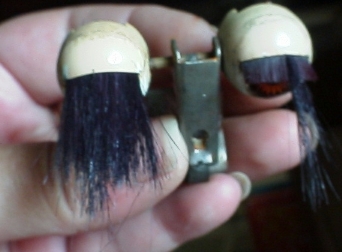 |
Keep adding lashes and pushing them to the side until the slit is packed with new lashes. |
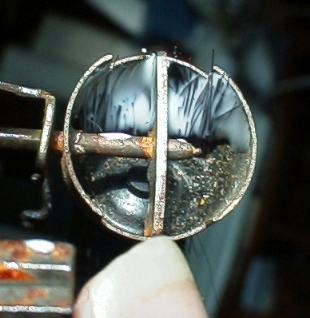 |
Once the lashes are all in place, paint Elmer's Glue along the slit and tamp it well into the lashes. On the front side, use your finger to even the thickness and angle. Set aside to dry. |
 |
Once dry, trim the lashes with sharp scissors so both eyes match. Now comes the tricky part—putting them back. Since clamping isn’t possible with the head intact, I use epoxy putty to secure the clinchers. |
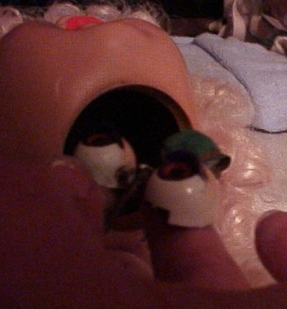 |
Gently spread the clamp open and put a small lump of putty inside. Hold the clamp on your finger and angle it into the neck opening. |
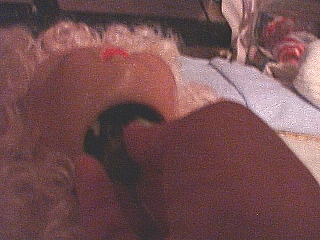 |
Hold the head face up and maneuver until the eyes appear in the sockets. Patience is key. |
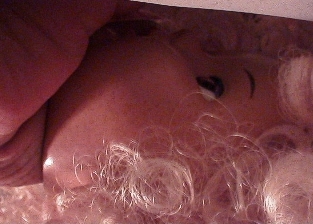 |
Once positioned, flip the head over and hold it above you so you are looking up at the face. |
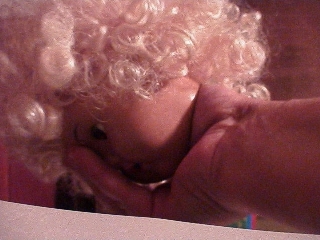 |
Adjust the eyes so the lashes rest evenly on the socket edge. Push the clamp firmly into the bridge of the nose and check open and closed alignment. |
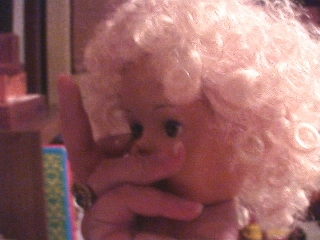 |
Once satisfied, turn the head face down and allow the epoxy to harden. |
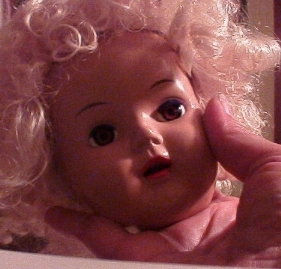 |
All done! Reattach the head by placing the hook inside and pulling the elastic into place. |
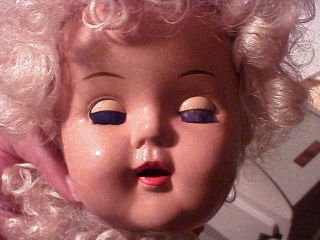 |
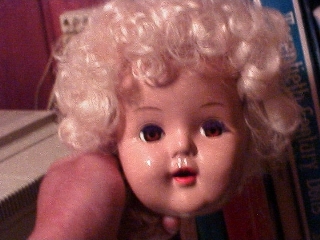 |
Warnings:
If you're short tempered, this project is not for you! Better to send it to the person who listed the doll and said the lashes were "easily replaced" (grin)
Suggestion
Practice getting the clinchers into the head and into position before you put the epoxy on the center clamp. Once you get good at it and you're sure you have the knack, then you'll be sure to get them in place and properly aligned before the epoxy sets up.